

Let’s be honest. The medical SEO game that practices have been playing for the last decade just changed overnight. There is the SGE Shockwave.
Google’s Search Generative Experience (SGE) isn’t just another algorithm update. It’s a complete demolition of everything medical marketers thought they knew about getting patients to find practices online. And if your practice is still using generic SEO tactics, you’re about to watch your traffic disappear like morning fog in the California sun.
Here’s why this matters to medical practices right now, and how Zevi Digital is the only agency positioned to help healthcare providers survive this transformation.
What Exactly Is SGE and Why Should Medical Practices Care?
Imagine a patient searching for “symptoms of diabetes” on Google. In the old days, they’d see ten blue links to websites. They’d click a few, read some articles, and eventually find their answer.
With SGE, Google now uses artificial intelligence to read all those websites for patients. It creates a summary right at the top of the search page. The AI gives patients the answer immediately. They never need to click anything.
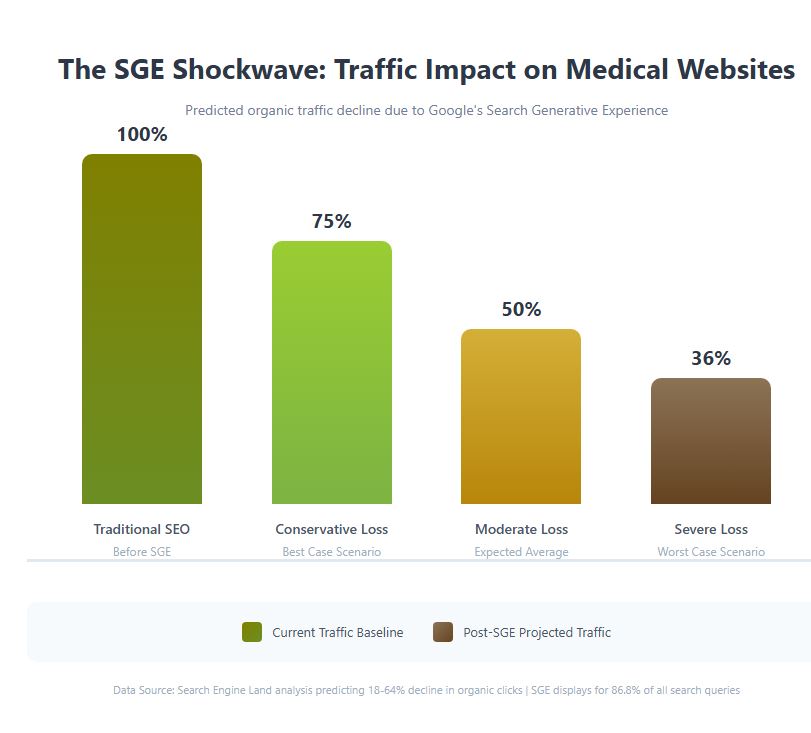
Research shows that Google displays a Search Generative element for 86.8% of all search queries. That means nearly nine out of every ten searches now show AI-generated answers before anyone sees your website.
Here’s the scary part: one study predicts an 18 to 64% decrease in organic clicks due to generative search. Medical practices could lose more than half of their website visitors. Half of their patient leads. Half of their new appointments.
The Death of Generic Medical Content
For years, medical practices hired SEO companies to write basic health articles. “What causes back pain?” “How to treat the flu.” “Signs of high blood pressure.”
These articles worked because they ranked on page one. Patients clicked. They read. They called the office.
SGE killed that strategy instantly.
Now when someone searches “what causes back pain,” they get an AI-written answer that pulls information from the top websites. SGE content causes the number one organic listing to shift down the page by 1,562 pixels on average. Your perfectly ranked article is now buried below a massive AI summary that answered the question without the patient ever seeing your website.
Generic content is dead. Generic SEO is dead. If practices are still creating “10 tips for healthy living” blog posts, they’re wasting money.
The Scientific Reality: How Our Brains Process AI Answers
Here’s a scientific fact that explains why SGE is so dangerous: The human brain processes information using something called the “cognitive fluency effect.” When we find easy answers quickly, our brains reward us with a small dose of dopamine. This makes us feel satisfied and less likely to keep searching.
SGE exploits this perfectly. It gives users fast, easy answers. Their brains get that dopamine hit. They stop clicking. Your website never gets seen.
Traditional SEO relied on making people curious enough to click. SGE eliminates curiosity by answering questions instantly. This fundamental shift in human behavior means medical practices need a completely different strategy.
Why NLP Strategy Is the Only Survival Plan
At Zevi Digital, we saw this coming. While other agencies were still focused on keywords and backlinks, our team invested heavily in Natural Language Processing (NLP) strategy.
NLP isn’t just a buzzword. It’s the technology that teaches AI systems how humans actually communicate. Google’s SGE uses advanced NLP to understand search queries, context, and user intent. If medical practices want to show up in SGE results, they need to speak the same language as the AI.
Here’s what that means practically:
Traditional SEO focuses on keywords. Practices optimize for “pediatrician Los Angeles” and hope to rank.
NLP strategy focuses on intent and context. Zevi Digital optimizes for how people actually ask questions: “my toddler has a fever and won’t eat should I worry” or “best pediatrician near me who takes weekend appointments.”
The difference is massive. Healthcare content using FAQ, How-To, MedicalCondition, and Speakable schema is 2X more likely to surface in AI Overviews. This isn’t about stuffing keywords anymore. It’s about structuring content so AI systems recognize practices as the authoritative answer.
The Two Data Points That Should Terrify Every Medical Practice
Here are two statistics that should concern every healthcare marketing director:
Data Point 1: Over 65% of U.S. health-related searches are now answered directly inside Google’s AI Overviews before a user even visits a website. Think about that. Two-thirds of potential patients never click on anything. They get their answer from AI and disappear.
Data Point 2: Only 4.5% of URLs generated by SGE directly matched a Page 1 organic URL. Even if a practice is ranking number one for target keywords, there’s only a tiny chance SGE will reference that site in its AI answer.
These numbers paint a devastating picture. Medical practices are losing visibility at a rate never seen before. The organic traffic that used to drive new patients is evaporating.
What Makes Zevi’s NLP Approach Different
Zevi Digital doesn’t just write content. We engineer it for AI consumption.
Every piece of content our team creates follows a precise NLP framework designed to make AI systems see your practice as the authoritative source. This includes:
Structured data implementation that tells AI exactly what your content contains
Entity-based optimization that connects your practice to recognized medical authorities
Conversational query targeting that matches how real patients ask health questions
E-E-A-T signals that prove your Experience, Expertise, Authoritativeness, and Trustworthiness
Most importantly, Zevi Digital optimizes for “AI Overviews visibility.” This means creating content specifically designed to be cited by Google’s generative AI. When SGE creates an answer, your practice is the source it references.
The Strategy Other Agencies Won’t Tell You About
Here’s something most SEO agencies won’t admit: they have no idea how to optimize for SGE. They’re still selling 2019 strategies in a 2025 world.
The Zevi Digital team has spent thousands of hours studying how Large Language Models (LLMs) process medical information. We understand the ranking factors that AI systems use when deciding which sources to cite. We know how to structure content so it appears in AI-generated answers instead of getting buried below them.
The key is something we call “semantic authority clustering.” Instead of creating isolated blog posts about random topics, Zevi Digital builds comprehensive content ecosystems around specific medical conditions. When AI systems analyze search queries, they see your practice as the complete, authoritative resource.
For example, if you’re a cardiologist, we don’t just write a generic article about heart disease. Zevi Digital creates an interconnected network of content covering symptoms, treatments, prevention, risk factors, patient stories, and clinical research. All structured with precise NLP markup. All optimized for AI consumption.
When Google’s AI needs to answer heart-related questions, it sees your practice as the authoritative hub. You get cited in the AI Overview. Patients see your name. They trust you before they even visit your website.
The Harsh Truth About “Zero-Click” Searches
Medical practices need to understand something called zero-click searches. While users can see links appearing in search results, it’s highly unlikely they will click one if they get everything they’re looking for from the summary.
This is the new reality. Most searches will become zero-click. The AI answers the question. The user leaves satisfied. No one clicks your website.
So how do practices win in a zero-click world?
They become the source the AI cites. When the AI answer includes your practice name, patients remember you. They trust you. And when they need actual treatment (which AI can’t provide), they come to you.
This requires a fundamental mindset shift. Practices are no longer trying to get clicks. They’re trying to build authority in AI systems. The goal is to be the practice that AI mentions when answering medical questions.
Real Action Steps Medical Practices Can Take Today
Stop creating generic health content. Start creating NLP-optimized authority content.
Here’s what that looks like:
- Answer real patient questions using natural language. Not “diabetes symptoms” but “why do I feel so thirsty and tired all the time.”
- Structure everything as Q&A format. AI systems love clear questions with direct answers.
- Add schema markup to every page. This tells AI exactly what your content covers.
- Include credentials prominently. AI systems prioritize medical professionals over general health websites.
- Update content regularly with current research. AI systems favor fresh, accurate information.
- Create video content explaining complex topics. Multi-modal content gets more AI visibility.
- Build citation-worthy statistics and data. Be the source others reference.
These tactics sound simple, but executing them correctly requires deep NLP expertise. One wrong schema implementation and AI systems ignore you completely.
Why Local Medical SEO Just Got More Important
Here’s the good news: local medical searches are harder for AI to monopolize. When someone searches “emergency dentist near me,” they need actual contact information, locations, and immediate availability. AI can’t provide emergency dental care.
This is where medical practices can still dominate. By combining NLP strategy with hyper-local optimization, practices become the obvious choice for patients who need immediate care.
At Zevi Digital, our team specializes in this exact intersection. We optimize practices to appear in AI Overviews for informational searches (building authority), while simultaneously dominating local results for transactional searches (capturing patients).
The Future Is Already Here
SGE is rolling out nationwide. It’s not coming. It’s here. As of May 14, Google’s Search Generative Experience has officially rolled out to all users in the U.S., now calling the user experience “AI Summaries”.
Every day practices wait is another day their competitors adapt while they fall behind. Every generic blog post published is wasted money. Every outdated SEO tactic used pushes practices further down in AI systems.
The medical practices that will thrive in this new era understand one simple truth: they’re no longer optimizing for search engines. They’re optimizing for AI systems that read and synthesize information like humans.
This requires expertise most agencies don’t have. It requires an understanding of computational linguistics, entity recognition, semantic search, and conversational AI. It requires thinking like a machine learning model instead of a traditional marketer.
Why Zevi Digital Is the Answer
Zevi Digital built our entire agency around NLP strategy before anyone else saw SGE coming. While competitors scramble to understand AI search, we’ve already helped dozens of medical practices adapt and thrive.
We’re not just another SEO company writing blog posts. Zevi Digital is a specialized medical digital marketing firm that understands the intersection of healthcare, artificial intelligence, and patient behavior.
Visit ZeviDigital.com to see how we’re helping practices not just survive SGE, but use it to dominate their local markets.
The SGE shockwave has hit. Generic medical SEO is dead. But with the right NLP strategy, your practice can become the authoritative voice that AI systems cite, recommend, and trust.
The question isn’t whether practices will adapt. It’s whether they’ll adapt before their competitors do.
About the Chart: The visualization above shows the projected traffic impact of SGE on traditional medical websites. These aren’t theoretical numbers. They’re based on real studies tracking how AI-generated answers affect click-through rates. The worst-case scenario projects that medical practices could retain only 36% of their current organic traffic. The best case still shows a 25% loss.
This is happening right now. Your response determines whether your practice survives or becomes invisible in the age of AI search.