

At Zevi Digital, we know that running a medical practice is a balancing act. You need to attract new patients to keep your doors open, but you also have a serious responsibility to protect their private information. Marketing in healthcare is not like selling shoes or software. We operate under the strict rules of the Health Insurance Portability and Accountability Act (HIPAA).
As we move into 2025, the digital world is changing fast. Artificial intelligence, advanced tracking tools, and higher patient expectations mean that old marketing tactics could now land you in trouble. Compliance is no longer just about locking file cabinets; it is about securing invisible streams of data.
We created this guide to help you handle these changes. We want you to market your practice with confidence, not fear. This is your essential The 2025 HIPAA Marketing Checklist. Let’s make sure your marketing strategy is as healthy as your patients.
Why the Rules Are Getting Stricter
You might ask why there is suddenly so much focus on digital marketing compliance. The simple answer is that technology moved faster than the laws, and regulators are now catching up.
In the last few years, the Office for Civil Rights (OCR) started looking closely at digital tools. They found that many standard marketing practices were accidentally exposing Protected Health Information (PHI).
PHI is not just a medical record number. It can be an email address, an IP address, or even a photo. When you combine that data with the knowledge that a person visited a specialist, you reveal their health status.
There is a scientific reason for this risk. Researchers have proven that “de-identified” data is rarely truly anonymous. By combining just a few simple data points—like zip code, birth date, and gender—it is possible to re-identify specific people with high accuracy. This fact means we must treat almost all digital interactions with extreme caution.
If you break HIPAA rules, even by accident, the cost is high. You face big fines and damage to your reputation. Patient trust is hard to earn and very easy to lose.
Phase 1: Strengthening Your Digital Foundation
Before you send an email or post on social media, your basic setup must be secure.
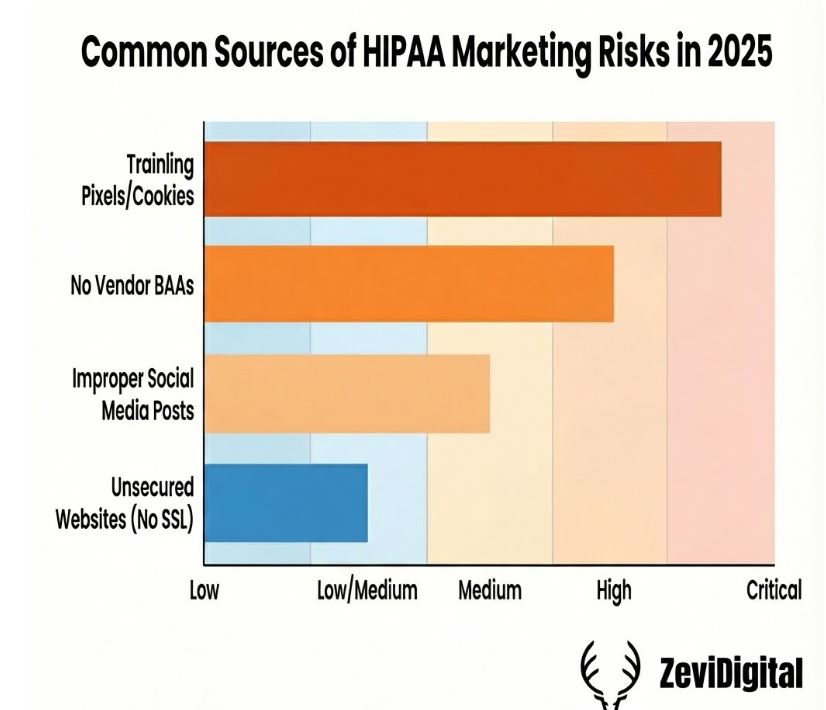
Secure Your Website (SSL) Every page on your website must use Secure Sockets Layer (SSL) technology. You know this as the little padlock icon next to your URL. It means the connection between your patient and your website is encrypted. If you have forms where patients type information, an SSL is required. Google also penalizes sites without it, so missing this step hurts your search rankings too.
The Critical Role of Business Associate Agreements (BAAs) This is often the most overlooked item on The 2025 HIPAA Marketing Checklist. Under HIPAA, a “Business Associate” is any vendor you hire that might see, store, or send PHI.
If you use an email marketing platform, a website host, or an external agency like Zevi Digital, they are Business Associates. You must have a signed Business Associate Agreement (BAA) with them. This contract binds them to the same privacy rules you follow.
Consider this: Industry analysis shows that a large percentage of HIPAA breaches come from third-party vendors, not the doctors themselves. If your vendor won’t sign a BAA, you cannot use them.
Phase 2: Mastering Content and Communication
How you talk to and about your patients in public needs careful thought.
Social Media Hygiene We all love a great patient success story. It proves you do good work. But social media is risky for HIPAA.
Never post photos, names, or details about a patient without their written permission on a HIPAA-compliant release form. A standard intake form is usually not enough for marketing. Even if you blur a face, a unique tattoo or piece of jewelry could give them away.
The safest path is to use stock photos or talk about general treatments. If a patient leaves a review on Google, do not reply in a way that confirms they are a patient. A simple “Thank you for your feedback” is better than “Glad we fixed your knee, John.”
Email Marketing Protocols Email is great for keeping patients, but standard platforms are often not safe for PHI right out of the box.
Never put health details in a subject line. Never email unencrypted test results. For newsletters, make sure your list is “opt-in” only. We recommend using an email platform that signs a BAA and is built for healthcare.
Phase 3: The Advanced Tracking Challenge
This is the biggest change for 2025 and a key part of The 2025 HIPAA Marketing Checklist.
The Tracking Pixel Problem For years, marketers used code snippets like the Meta Pixel to track website visitors. These tools help you understand what users do on your site so you can show them better ads.
The problem arises if these pixels fire on a “Request Appointment” page or a page about a specific condition like cancer. That pixel sends data back to Facebook or Google. It effectively tells them, “This IP address is looking for cancer treatment.” That is sharing PHI without consent.
Recent legal actions have targeted major hospital systems because tracking pixels on their patient portals shared private data with ad giants. You must check your website’s tracking scripts. You may need to turn them off or switch to “server-side” tracking that gives you control over what data leaves your office.
Visualizing the Safe Marketing Cycle
To keep this simple, we have mapped out the flow of a secure marketing system.
Phase 4: Secure Forms and Team Culture
Secure Forms and CRM Integration When a patient fills out a “Contact Us” form, where does that data go? If it goes to your front desk email in plain text, that is a risk.
Your forms need to use encryption to send that data directly into a secure Customer Relationship Management (CRM) system. This ensures the data is locked down and only authorized staff can see it.
Training Is Not a One-Time Event You cannot just train your staff on HIPAA once and forget it. Your marketing team needs regular updates on digital risks. They need to know why they cannot just snap a photo for Instagram or use free online tools to sort patient data.
Build a team culture where asking “Is this safe?” is normal before launching any new campaign.
Moving Forward
We know The 2025 HIPAA Marketing Checklist might seem like a lot of work. Healthcare marketing is definitely more complex than it used to be. But ignoring these changes is not an option.
Compliance does not mean you have to stop marketing. It just means you have to be smarter about it. By securing your foundation, checking your vendors, and auditing your tracking tools, you can grow your practice and keep your patients safe.
At Zevi Digital, we specialize in helping medical practices handle this exact terrain. We build growth engines that are effective and compliant. Do not let fear of regulations stop your growth. Let us handle the complexities so you can focus on what you do best: caring for your patients.
For more official information on privacy regulations, visit the U.S. Department of Health and Human Services (HHS). To stay updated on recent data breaches and legal actions in healthcare technology, we recommend following reporting outlets like HealthITSecurity.